"I know it's wrong, but I just can't help it..."
Manman (pseudonym) is 36 years old and works as a middle manager in a foreign company. She has a good family.
Her husband owns his own company and travels frequently across the country. Although he's busy with work, he treats her very well, often giving her gifts and creating romantic moments whenever he has free time. They also have a nanny, so she doesn't have to worry too much about the elderly or the children.
Colleague C had always admired Manman , often showing concern for her well-being and offering to take her home. Over time, Manman began to depend on C, and their relationship eventually spiraled out of control.
"I'm conflicted and suffering, but I also feel a vague sense of happiness..."
A survey reveals that 76% of people have cheated on their partners multiple times.
The Civil Affairs Bureau conducted surveys on infidelity in 2000 and 2005. The results showed that the male infidelity rate was 11.8% in 2000, while in 2005, this figure had tripled to 34.8%. This means that 3.4 out of every 10 married men had an extramarital affair, a truly alarming number.
In 2016, "Facts" released a survey on attitudes toward infidelity through online social platforms. In just a few days, 70,000 netizens filled out the questionnaire.
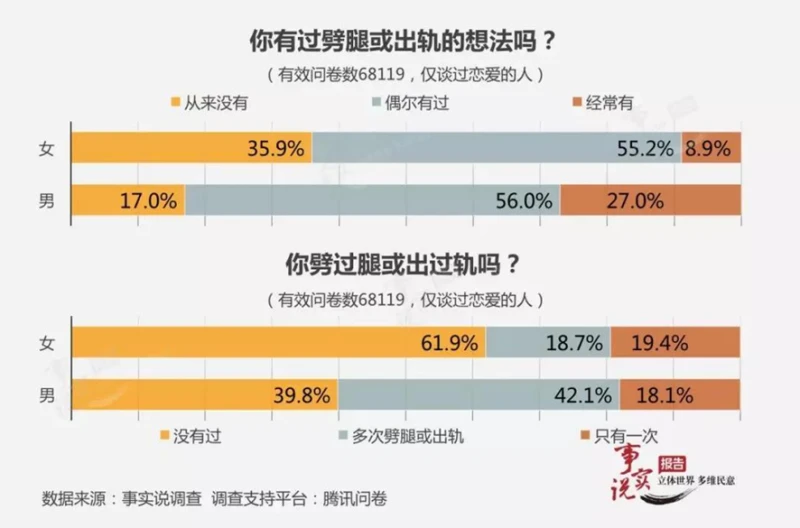
Data from the collected questionnaires shows that only 11.9% of respondents had never cheated, while 76.2% had cheated or had affairs multiple times, and 12% had only cheated once. Among them, more than 60% of women had thoughts of cheating, while more than 80% of men did. Of these, more than 40% of women and nearly 60% of men actually committed infidelity.
If marriages are happy, why do so many people still risk having affairs?
"Infidelity" has long attracted the attention of anthropologists and sociologists. The famous Kinsey Reports revealed that more than one-third of men had cheated on their wives, and 26% of married, divorced, and widowed women had extramarital affairs before the age of 40. These figures were from the 1940s.
Why is infidelity either zero times or countless times? American anthropologist Helen Fisher points out that there may be biological principles supporting the phenomenon of infidelity .
First, infidelity may be human nature , and this nature may have already formed in the ancient prehistoric period.
Like other animals, infidelity is essentially the behavior of mating with multiple mates and producing offspring; it is an adaptive mechanism that brings about genetic diversity in the next generation. For example, some birds may mate with different males simultaneously to maintain a diverse combination of genes.

Secondly, Fisher also believes that humans have evolved three basic brain systems that guide courtship and reproduction : libido, attachment, and love. However, the correlation between these three brain systems is not always high; that is, these three brain systems do not necessarily act on the same object . Therefore, the phenomenon of "having multiple partners" can be explained biologically.
Besides evolutionary factors, genes also play a role in infidelity .
An experiment with orange-bellied voles showed that differences in specific gene composition of the vasopressin receptor in male voles lead to varying degrees of mate compatibility, one indicator being the sexual fidelity of male voles towards females. The vasopressin receptor gene is very similar in humans and mice , which further supports the idea that different men exhibit varying degrees of mate fidelity.
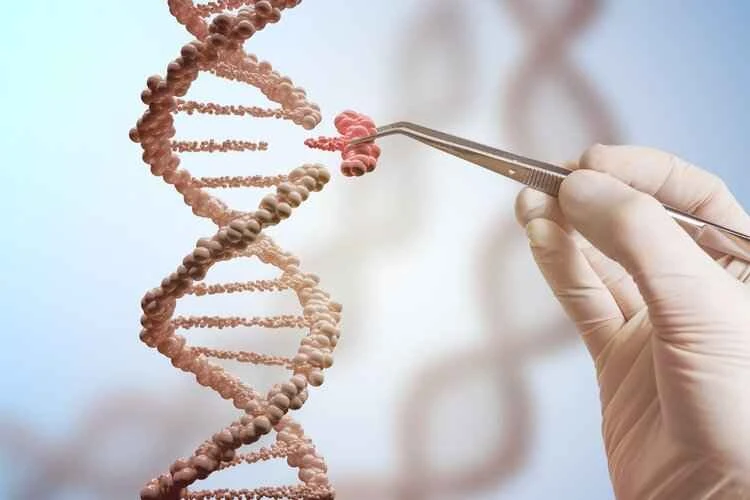
A Swedish study aimed to understand the influence of genes on infidelity. The 552 men surveyed were either married or had been living with their partners for five years or more.
The results showed that men with this gene scored very low on questionnaires measuring their attachment to their spouses. Conversely, those without this gene scored very high and were less likely to cheat . This confirms that infidelity can be influenced and interfered with by genes.
Humans are inherently jealous animals.
Scholar Fisher also mentioned in his book that humans are inherently a jealous species . Unlike most mammals that raise their offspring in groups, humans first form a "family." As this pairing relationship developed, the human brain long ago developed the instinct to maintain this relationship —humans like to control, are reluctant to share, and are prone to jealousy.

That being said, even if infidelity can be explained by biological principles, these principles cannot excuse the infidelity .
We are not puppets of our genes. A person's life is not determined at the moment of gene combination; it is also influenced by many environmental factors. Therefore, we can and should make the right choices about our lifestyle, instead of blaming everything on our genes.
How can one avoid infidelity and minimize harm to others?
Infidelity undoubtedly hurts those closest to you and destroys families. So what can be done to prevent this from happening and minimize the harm?
1. Understand your true inner needs before marriage.
Many young people today rush into marriage under pressure from parents or other external forces without even having much dating experience. Such marriages are fundamentally unstable; the people getting married don't know what they truly want, making them more prone to change after marriage. Therefore, marriage shouldn't be rushed; one must carefully examine their own heart and consider things thoroughly.

2. When you encounter problems, don't use infidelity as an escape.
No one's life is perfect. Everyone encounters setbacks in life, and it is precisely because of this that partners need to support each other and overcome difficulties together, rather than escaping reality and seeking outfiring to vent negative emotions.
3. Be honest and open with each other.
When misunderstandings and conflicts arise between husband and wife, they should open up to each other as soon as possible and talk everything out in order to truly resolve the problem.
In recent years, "scumbag men" and "scumbag women" have become popular terms. People abhor infidelity, yet they are unaware that marital infidelity is actually quite common nowadays. While biological principles and genetics certainly play a role, it is more a matter of personal choices. We should be responsible for ourselves and our partners.
References:
[1] Is infidelity a form of self-salvation or self-destruction? . Yixinli. 2018-10-31
[2] Even in a happy marriage, why would someone cheat? Sanlian Life Weekly. 2020-04-06