Imagine you're standing in line at the supermarket and you see someone ahead of you buying eco-friendly products—like sunglasses made from 100% recycled ocean plastic or shoes with no animal-derived ingredients. How would you rate this person? Would you find them more appealing than most people?
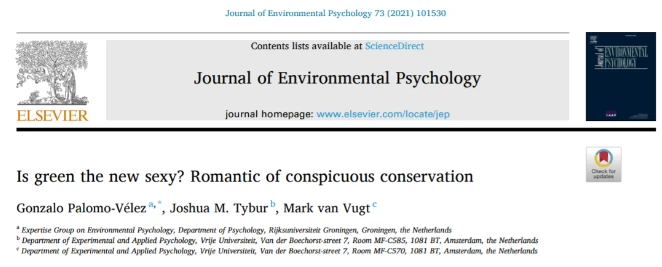
A recent paper published in the Journal of Environmental Psychology by Palomo-Velez, an expert from the Department of Environmental Psychology at the University of Groningen in the Netherlands, suggests that people who prefer to buy environmentally friendly products are considered more attractive than those who buy traditional products, as this may indicate that they are generous.
This pro-environmental behavior is similar to conspicuous consumption (i.e., gaining recognition and status by displaying one's wealth), and its purpose is to convey positive qualities to others, such as generosity, altruism, social reputation, and higher social status. These positive qualities may increase a person's attractiveness as a romantic partner.
Survey on the purchase and attractiveness of environmentally friendly products
In two studies, Palomo-Velez et al. tested whether a preference for environmentally friendly products could affect a person’s attractiveness to potential partners, and whether mating environments could influence decisions to purchase environmentally friendly products.
Study 1
Sample: 483 heterosexuals (53% male, average age 25).
Design: 2 (participant gender: male or female) x 2 (item price: expensive or cheap) x 2 (consumption type: eco-friendly or conventional).
Participants were instructed to rate the attractiveness of an individual of the opposite sex who purchased one of 12 products (such as a shirt, dishwasher, grill, and batteries). Each product had four versions (i.e., expensive vs. cheap, green vs. non-green). Participants rated the individual based on factors such as generosity, wealth, social orientation (willingness to have sex), and expectations of future relationships (including short-term and long-term relationships).
Study 2
Sample: 605 heterosexuals (60% male, average age 25).
Design: 2 (Consumption type: eco-friendly or conventional) x 2 (Item price: cheap or expensive) x 2 (Participant gender: male or female) x 2 (Motivation: mating or control conditions).
To emphasize mating motivation, one half of the sample was initially shown several attractive images of the opposite sex and asked to imagine having a dating prospect. The other half served as a control. All participants were then asked to rate the likelihood of purchasing four versions (combinations of product type and price) of 12 presented products. This tested whether people were more likely to buy eco-friendly products when they had a mating prospect.
result
Data analysis shows that people rate inexpensive, environmentally friendly products more positively than expensive traditional products. Furthermore, women place greater emphasis on sustainable and environmentally friendly products compared to men.
More importantly, data shows that people who buy environmentally friendly products (compared to those who buy traditional products) are considered more ideal romantic partners in both short-term and long-term relationships.

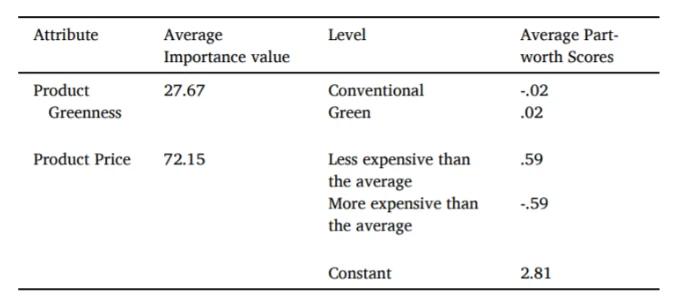
These results support some of the authors' predictions, such as the link between purchasing environmentally friendly products and perceptions of attractiveness; however, they do not support other predictions, such as that men may express a preference for purchasing environmentally friendly products in situations where they have a partner (mating object) (as a signal of their generosity and attractiveness).
In conclusion, this study suggests that purchasing environmentally friendly products appears to increase a person's attractiveness as a romantic partner compared to buying traditional products. This may be because people perceive those who buy environmentally friendly products as more generous, and generosity is attractive.
Furthermore, the authors found that men who purchased eco-friendly products were perceived as more socially restricted compared to those who purchased traditional products. In other words, people who bought eco-friendly products were perceived as less interested in or open to sexual activity outside of committed relationships.
Copyright Notice:
Original content from www.39.net. Unauthorized reproduction is prohibited and will be prosecuted. For content cooperation, please contact: 020-85501999-8819 or [email protected]