Now, scientists have discovered an effective way to predict breakups: the language patterns used by couples on social media change three months before a breakup. The findings were published in the journal PNAS.
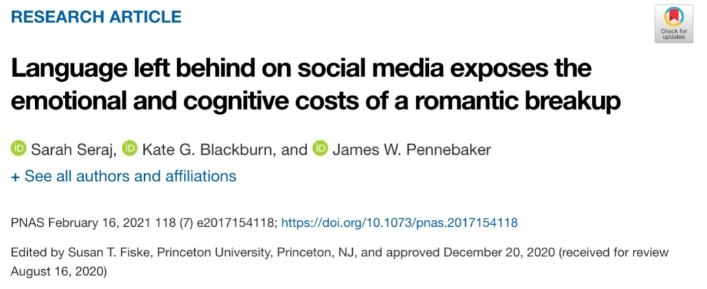
In this study, researchers collected over one million posts from 6,803 users on Reddit, covering various aspects of the participants' lives over two years, not just posts related to their romantic relationships. They then analyzed the social media language characteristics of these posts before and after the couples' breakups through text processing.
Researchers have found that couples' social media language patterns changed three months before a breakup, peaking a week before the breakup and returning to normal patterns six months later. Normally, people don't really notice how often they use prepositions, articles, or pronouns, but these function words change when experiencing emotional and psychological turmoil, and these changes can tell us about their emotions and psychological state.
Research has found that before a breakup, those posting online use the words "I" and "we" more frequently, showing signs of increased self-awareness. Regardless of whether the post is about the breakup, their language becomes more personalized and informal. These changes in language suggest they are carrying a heavy cognitive burden and are increasingly focused on themselves. The use of the word "I" is associated with frustration and sadness.
Furthermore, researchers found that the more people posted online, the harder it was for them to recover from the breakup. When people are depressed, they are less able to build relationships with others. Compared to participants who posted for a short period, those who posted breakup information over a longer period were still finding it difficult to move on from the pain a year after the breakup, possibly because they repeatedly recalled the moments they shared with their partner, making it hard to escape the shadow of grief. Similar changes in language patterns were also observed in those who had experienced divorce.
Research on the trajectory of relationship breakdown dates back to 1984. A study published in the Journal of Social and Personal Relationships described five stages of relationship breakdown: Discovery of Dissatisfaction (D), Exposure (E), Negotiation (N), Resolution (R), and Transition (T). An analysis of 112 retrospective studies on relationship breakdowns found that couples in the Exposure (E) and Negotiation (N) stages experienced more prolonged and worse relationship conditions. The duration of the breakup (from D to T) was directly proportional to the mutual attraction and sense of identification between the partners, and positively correlated with feelings of loneliness and fear after the breakup.

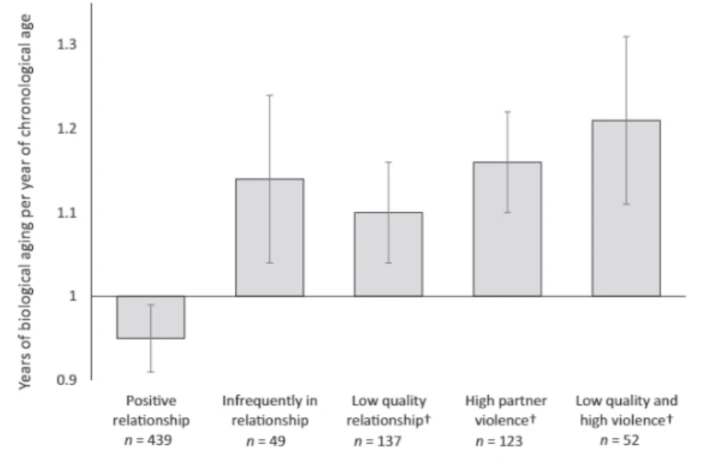
While most breakups are heartbreaking, not all are bad. A study published in the journal Psychology and Aging shows that people in low-quality relationships age faster physically than those in high-quality relationships.
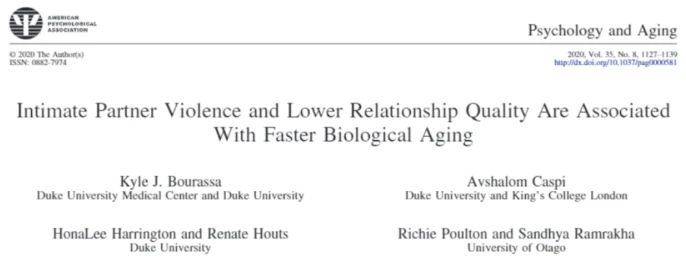
In this study, researchers investigated 1,037 participants born in New Zealand between April 1972 and March 1973, analyzing their romantic relationship characteristics, relationship quality, and partner violence at four age points: 26, 32, 38, and 45.
The study found that as time went on, increasing emotional and life stress correlated with a decline in the health of one's partner. Psychological violence was more common across all age groups. At age 32, the incidence of physical and psychological violence by either partner was as high as 71.7%, decreasing by age 45. Those who experienced partner violence actually aged faster, especially those who suffered physical violence. Furthermore, there was an independent relationship between relationship quality and partner violence and biological aging.
Furthermore, a study published in the Journal of Personality found that romantic relationships during adolescence can have a positive impact on personality development, especially for neurotic individuals. Neuroticism is one of the five basic personality traits described in psychology. Neurotic people tend to be timid, anxious, easily agitated, prone to depression, and have low self-esteem and dissatisfaction with life. However, during romantic relationships, these individuals tend to experience greater emotional stability, which can also promote positive personality development.
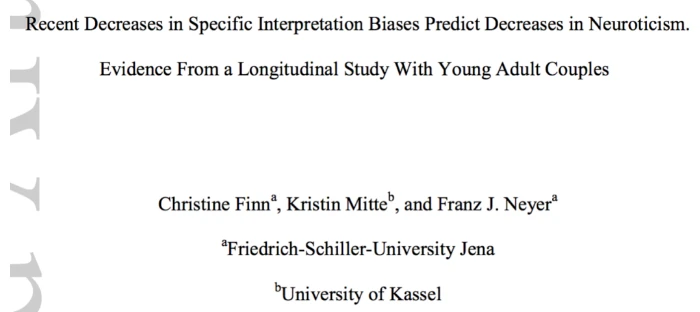
In this study, researchers followed 245 couples aged 18-30 for nine months, administering individual questionnaires every three months. The questionnaires investigated the couples' levels of neuroticism and satisfaction with their relationships. In addition, participants rated hypothetical everyday scenarios and their relationships with their partners.
Research shows that neuroticism gradually decreases in romantic relationships, and both partners grow together. However, the more crucial factor is the impact on the cognitive level, specifically the inner world. Positive experiences and feelings with a partner don't directly change personality, but rather counteract negative emotions through a shift in mindset. In other words, love can help people navigate life with greater confidence, rather than persevering in pessimism.
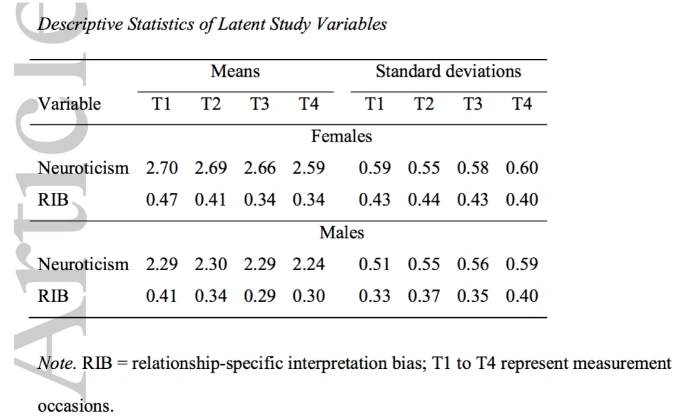
The study further emphasizes that a long-term, stable romantic relationship has a more significant effect than a short-term one, and this effect was observed in both male and female participants. Furthermore, not only for neurotic individuals, but also for those suffering from depression and panic disorder, romantic relationships can gradually change pessimistic thoughts.
It is evident that good love keeps one young, while disharmonious love makes one appear aged. A Harvard study spanning 82 years on human happiness found that intimate relationships are particularly important for a person's health and well-being, especially in today's more stressful and impactful society.
Having someone to support and encourage you is a special kind of wealth. Research shows that close relationships are not just about money or fame, but also a cause of lifelong happiness. Compared to social class, IQ, and even genes, these bonds can protect people from life's dissatisfactions, help delay physical and mental decline, and contribute to longevity.
Researchers emphasize that good relationships not only protect our bodies but also our brains, and we don't have to maintain a constant, stable relationship. Some couples in their eighties may argue day after day, but as long as they can truly rely on each other during difficult times, these arguments won't damage their memories.
In short, high-quality intimate relationships can help slow down aging and improve overall well-being. If a person enjoys a harmonious and sweet love life, a peaceful parent-child relationship, and passionate work, they will rarely experience worries and pain. Therefore, whether it's a breakup or being in an unhealthy relationship, seeking a positive lifestyle is always beneficial to one's health.
The above content is exclusively authorized for use only and may not be reproduced without the copyright holder's authorization.