In her novel "Red Rose, White Rose," Eileen Chang satirized men who were fickle in love in this way:
"A man will meet two roses in his life. If he marries the red rose, over time, the red will fade into a smear of mosquito blood on the wall, while the white will remain the bright moonlight before his bed; if he marries the white rose, the white will become a grain of rice stuck to his clothes, while the red will be a cinnabar mole on his heart."
Perhaps you once swore that you would never change your mind, but as time goes by, can you still guarantee that you won't cheat?
From 2000 to 2015, a research team from the Institute of Sexual Sociology at Renmin University of China conducted a nationwide random sampling survey of the total population, which included detailed data on extramarital sexual behavior in China: during the 15 years of the survey, the proportion of men and women who had had extramarital affairs continued to increase. [1]
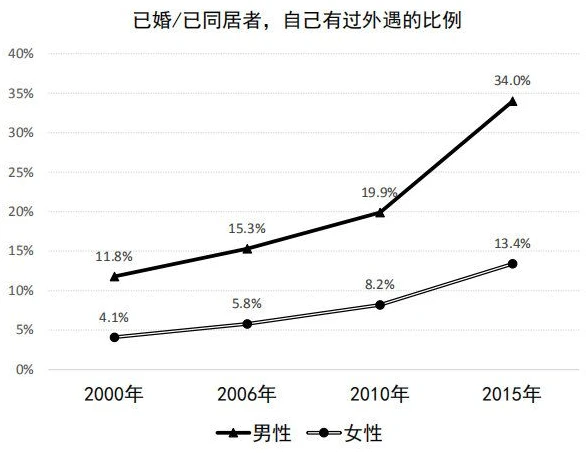
Percentage of extramarital affairs / Source: Reference [1]
From 2000 to 2015, the male infidelity rate rose from 11.8% to 34.0%, while the female infidelity rate increased from 4.1% to 13.4%. By 2015, approximately one in three husbands and one in seven and five wives had been unfaithful.
No matter how many vows of eternal love were made, the data still confirms that the infidelity rate in today's society is constantly rising. Even the most steadfast sweet words may not be able to stop many people's wandering hearts.
Why do people always lose control of themselves and choose to cheat and seek excitement?
From a scientific perspective, there are indeed some "restless factors" hidden in people's bodies!

1. Is infidelity a human instinct?
In fact, most animals will "cheat".
To better perpetuate their genes, animals will try their best to find better mates. However, if they cannot find a mate, they will secretly mate with other high-quality members of the opposite sex in addition to their social mates to obtain better genes. This is the result of natural selection .
Furthermore, like all mammals, humans are naturally prone to novelty-seeking. This is because a strange partner provides a far greater dopamine boost than a familiar sexual partner.

In the field of biology, there is a famous "Coolidge effect." Scientists conducted experiments on rats and found that every male mammal will become bored with a single sexual partner , but if it is a new sexual partner, the male animal will continue to show high sexual desire.
Based on this effect, it's also understandable why middle-aged men are listless in front of their wives but can be incredibly virile in bed with their lovers...
Therefore, it seems that the potential for infidelity truly exists in the human brain. But why are some people able to hold onto their rationality, while others are easily swayed?
II. Loyalty and infidelity may originate from the genes within your body!
(a) "Infidelity-prone genes" are restless factors in the human body.
1. DRD4 gene
In 2010, a research team from the State University of New York discovered a gene, DRD4, linked to infidelity, by surveying 180 young men and women. [2]
Studies show that approximately 25% of people possess the "love cheater gene," making them more than twice as likely to be unfaithful. Among volunteers carrying the DRD4 gene mutation, 50% have cheated on their partners, and once they do, they are more likely to have a one-night stand. In contrast, only 22% of those without the gene mutation have cheated.
Dopamine is a reward given to us by the brain, and its appearance makes us feel "pleasure". The role of DRD4 is related to the dopamine "burst" under behaviors with high risk, high reward and different incentives.
The study also found that people carrying the D4 receptor are more likely to have affairs and one-night stands, and are also more prone to gambling and alcoholism. This indirectly proves that infidelity is just as addictive as gambling and alcoholism; once you start, you might do it a thousand times.
2. V1aR gene
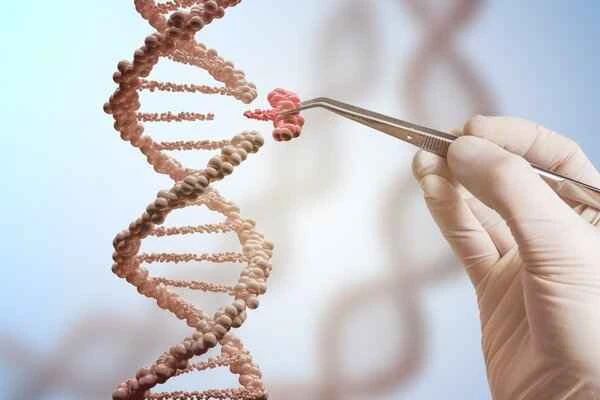
A study published in the journal Science showed that prairie voles are monogamous, adhering to a lifelong monogamous relationship, while their close relatives, mountain and meadow voles, pursue endless one-night stands. [3]
The results showed that the striking difference between the two types of voles' brains was due to their DNA differences, with significant differences in the content of the V1aR gene in the brains of the two types of voles.
This finding also applies to humans: men carrying multiples of the V1aR gene have a 34% chance of experiencing marital crisis or divorce, compared to only 15% carrying a single V1aR gene.
3. AVPR1A gene
Everyone has two AVPR1A genes, one from each parent, which can give rise to many different combinations. Regardless of the extent of genetic differences caused by these combinations, they can have a significant impact on behavior. Some of these combinations are associated with promiscuity.
A research team at the University of Queensland in Australia studied the DNA and life histories of 7,378 men and women and found that 6.4% of the women had committed adultery, and a large proportion of them carried the mutated AVPR1A gene. Furthermore, AVPR1A did not appear to affect male behavior. [4]
(ii) In addition to the "cheating gene," there is also the "marital harmony gene."
Interestingly, humans possess not only a "cheating gene" but also a "marital harmony gene." People with this gene mutation tend to have more harmonious marital relationships and are less likely to divorce!
In February 2021, researchers at the University of Arkansas published a research paper on "genes for marital harmony" in the journal Scientific Reports. [5]
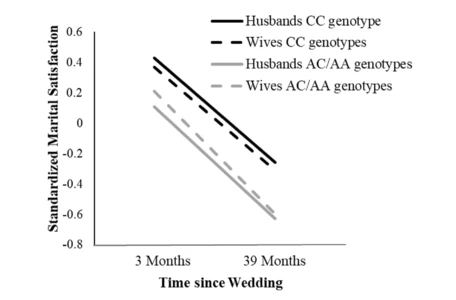
Different gene types affect marital satisfaction / Image source: Reference [5]
This study recruited 71 newlywed couples and the results showed that people with the CC genotype at the rs3796863 locus of the CD38 gene were more grateful to their partners, had higher levels of trust and tolerance, and had higher levels of marital satisfaction than people with the AC/AA genotype.
Third, is infidelity an excuse for being "genetically controlled"?
Scientists have identified the root cause of human infidelity, suggesting that people are genetic toys, infidelity is "uncontrollable," and an ineradicable original sin. In response, some companies have even launched "infidelity gene testing projects"...
But can genes really be used as an excuse for infidelity?

In fact, genes are just a window into how human physiology affects our behavior, and not everyone with these genes will have one-night stands or other infidelity.
Human behavior is also influenced by individual consciousness and environmental factors . From promiscuity in primitive times to polygamy in feudal society, and then to monogamy in civilized society, each advancement in emotional relationships has been built upon the development of civilization and mutual respect.
Genetics are not an excuse for infidelity; humans can tame their instincts. Remembering the promises we make is the true dignity of being human.
References:
[1] Pan Suiming, “Leaving Historical Evidence for ‘Quanxing’”
[2] Is Infidelity Genetic? Link: https://www.webmd.com/sex-relationships/news/20101201/is-infidelity-genetic
[3] Monogamous Minds Link: https://www.sciencemag.org/news/2004/06/monogamous-minds
[4] Is it true that women cheat because of the AVPR1A gene? http://www.uux.cn/viewnews-70220.html
【5】CD38 is associated with bonding-relevant cognitions and relationship satisfaction over the first 3 years of marriage Link: https://www.nature.com/articles/s41598-021-82307-z
The above content is exclusively authorized for use only and may not be reproduced without the copyright holder's authorization.