In one of her outpatient clinics a few years ago, Sister Chao saw a 51-year-old woman who had just entered perimenopause and was experiencing some typical symptoms, including hot flashes, excessive sweating, insomnia, and irritability.
This is a common case in gynecology. After Ms. Chao gave her treatment suggestions, the woman seemed hesitant to leave. Only after repeated questioning did she stammer that she and her husband had not had marital relations for nearly a year, and her husband often complained about it. She didn't know what to do.
Chao asked her why she didn't have it. She countered by asking: "Women age after menopause, can they still have sex?"
Many people believe that sexual intimacy is a privilege reserved for young people, especially after menopause, when many women feel they are no longer capable of having sex.
However, this view is incorrect.
Women often find it difficult to talk about sexual issues after menopause.
Menopause is a period that every woman will experience. During menopause, women experience many physiological changes due to the rapid decline in estrogen levels .
According to a survey, 90% of Chinese women believe that the decline in sexual function during menopause is natural due to aging. Especially in China, where the social atmosphere is relatively conservative, very few menopausal women seek help from doctors , and only 3% will take the initiative to inquire about it .

In fact, decreased sexual function during menopause is not an inevitable outcome. Menopausal women who have questions about sex should actively consult a doctor about their health issues and should not feel ashamed of sex .
Women can maintain good sexual function after menopause.
A study of over 2,000 Chinese women revealed that while the vast majority of postmenopausal women still have sex lives, 70.9% reported a decline in sexual function , and 18.6% reported having no sex life at all . However, some women maintained good sexual function. The study suggests that the decline in sexual function in postmenopausal women is not entirely due to physiological factors .
Aside from physiological and male factors, the main reasons why women reduce or stop having sex are related to their beliefs and perceptions .

The decline in estrogen levels and loss of muscle elasticity caused by menopause can affect the quality of a couple's sex life. Combined with the functional decline in middle-aged and older men, many women inevitably reduce or stop their sexual activity. However, this does not mean that postmenopausal women lose their sexual expression . Surveys show that 70.1% of postmenopausal women satisfy their needs in other ways, meaning that women still have physiological needs even in old age, and menopause does not equate to the loss of sexual function .
Maintaining a normal sex life has many benefits for postmenopausal women.
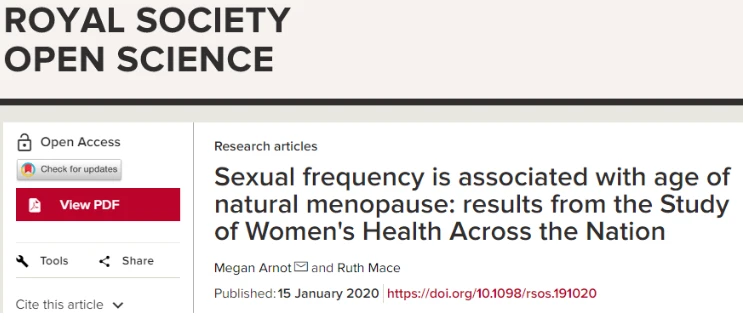
On January 15, 2020, Megan Arnot et al. from University College London published a study titled "Sexual frequency is associated with age of natural menopause: results from the Study of Women's Health Across the Nation." This study analyzed 2,936 women and found that women who had sexual intercourse weekly were 28% less likely to experience early menopause than women who had intercourse only once every few months or not at all . Increasing the frequency of sexual intercourse before and during the perimenopausal period also helped women reduce the risk of menopausal symptoms.
In addition, there are many benefits to postmenopausal women maintaining a normal sex life.
1. Slowing down aging . Appropriate sexual activity can help postmenopausal women alleviate the discomfort caused by declining hormone levels, while also contributing to endocrine balance, thus slowing down aging and giving them a radiant complexion.
2. Boosts immunity . During sexual activity, various organs and systems in the body are active and functioning, which has a positive effect on strengthening the body and boosting immunity.
3. Enhance marital affection . After many years together, a couple's feelings may become mundane, and they may often revolve around their children. However, life needs a little spice and surprise, and marital intimacy can help enhance their relationship.
4. Prevention of gynecological inflammation . During a healthy sexual relationship, the blood flow to the uterine lining is richer, and the local flora can be adjusted, which helps reduce the occurrence of gynecological inflammation.
Further reading: Several points to note regarding postmenopausal sexual activity
While postmenopausal sex life is generally good, there are a few things to keep in mind.
• Because estrogen levels drop after menopause, secretions decrease significantly, which may cause dryness, affecting quality and causing pain. In this case, some lubricating products can be used to reduce discomfort and pain.
• After menopause, women's vaginal resistance decreases, increasing the chance of infection. Therefore, it is important to clean the area before and after intercourse to avoid infection.
• Before starting, focus on relaxation and enjoyment, and do more preparation to improve the quality of your sex life.

Women should face their needs honestly and without shame regarding sex. Postmenopausal women should actively manage the issues that arise during menopause and address any unspoken difficulties they may encounter in their sex life.
References:
[1] Hou Min, Tang Maoqin. A study on the quality of life and related factors of perimenopausal women [J]. Chinese Journal of Clinical Psychology, 2010: 115-117+120.
[2] Can I still have sex after menopause? . Obstetrics and Gynecology Hospital Affiliated to Fudan University. 2019-01-07
[3]Arnot Megan and Mace Ruth 2020Sexual frequency is associated with age of natural menopause: results from the Study of Women's Health Across the NationR. Soc. open sci.7191020
Reproduction without the author's permission is prohibited.