Anxiety about appearance has become a common concern among young people today.
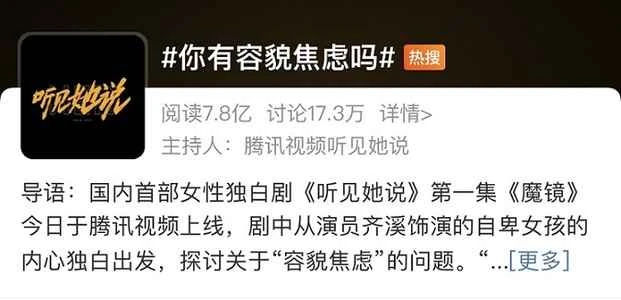
In 2021, the topic of "appearance anxiety" repeatedly trended on social media in various forms, with the hashtag #DoYouHaveAppearanceAnxiety# alone garnering 780 million views.
According to a survey conducted by China Youth Daily's Campus Media among 2,063 college students nationwide, 59.03% of college students experience some degree of appearance anxiety. [1]
"Single eyelids, deep neck wrinkles, flat nose, acne scars on my face, large pores, or I wish I were thinner..." Ke Yi, who is 168 cm tall and weighs 92 catties, sighed while scrolling through short videos.
There are quite a few girls like her who feel anxious and inferior because they think they are "not beautiful enough".
Most girls trapped in "appearance anxiety" choose to deceive life with photo editing software , using beauty filters to edit their selfies to make up for their "appearance defects." Data shows that as of the first half of 2020, Meitu Xiu Xiu had a total of 295 million monthly active users, with an average daily usage time of 15.4 minutes . [2]
Meanwhile, another group of girls who are subjected to appearance anxiety-based psychological manipulation choose to grasp at plastic surgery as a "lifeline".
In the June episode of "Super Speaker: Youthful Spirit," Zhou Chuna, a Gen Z internet celebrity, mentioned in her speech that during her upbringing, she noticed that good-looking people always received preferential treatment. As a result, trapped in a quagmire of anxiety and low self-esteem, she began undergoing cosmetic surgery at the age of 13, spending approximately 4 million yuan to give herself a more beautiful face. Cosmetic surgery seems to have become a bottomless pit in her life, something she can neither stop nor turn back from.
Another girl caught in the grip of appearance anxiety suffered an even greater tragedy. On July 13, Xiao Ran, a female internet celebrity from Hangzhou , died from an infection caused by a liposuction procedure performed improperly at a hospital. The 33-year-old, with a beautiful face and slender waist, ultimately succumbed to the complications of the "weight loss" surgery.

However, despite numerous vivid examples, many people still flock to cosmetic surgery due to appearance anxiety. Topics such as graduates flocking to get cosmetic surgery during summer vacation, getting "elf ears" (a type of cosmetic surgery), and calf nerve block surgery remain popular.
The words "If you don't become more beautiful, you'll be left behind by the times!" fill their ears, but those girls caught in the vortex of anxiety don't know that feeling ugly can sometimes be a mental illness— body dysmorphic disorder (BDD).
According to the diagnostic definition in the Diagnostic and Statistical Manual of Mental Disorders (DSM), people with body dysmorphic disorder are overly concerned with their physical defects , even though these defects are actually insignificant. This disorder can also lead to depression, eating disorders, excessive cosmetic surgery, suicidal behavior, and so on. [3]
Body dysmorphic disorder is not caused by a single factor. In addition to personality traits and childhood sarcasm/bullying/discrimination, there is another important factor— social media.
Upon opening Douyin, Weibo, Xiaohongshu, and various live streaming platforms, we seem to enter a gentle paradise filled with handsome men and beautiful women. However, a study published in Body Image by the University of York found that browsing these visually appealing photos and videos on social media can affect self-perception of appearance, leading to lower self-evaluation of one's appearance. [ 4]
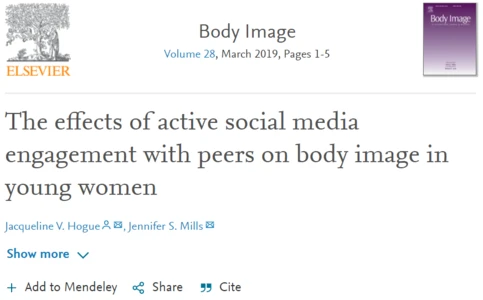
The study, conducted between 2016 and 2017, involved 118 women aged 18-27. Participants were first asked to complete a questionnaire about their self-perception of their appearance. They were then asked to log onto Facebook and Instagram to interact online with people of similar age for 5 minutes or longer. The results showed that after these online interactions, their negative self-evaluations increased.
Researchers explain this by saying that women are perceived as more attractive on social media than in real life. When test subjects unconsciously compare themselves to these idealized images on social media, it leads to a body image of "I am terrible".
The longer one spends in this social media environment, the greater the risk of body dysmorphic disorder. Even if it doesn't develop into a disease, it's difficult to remain unaffected, leading to more critical self-evaluation of one's appearance. In fact, beauty doesn't require perfectly proportioned features. If the thought "I'm ugly" constantly plagues you, making you dislike yourself and averse to social interaction, then perhaps you should stop pursuing "extreme beauty" and seek help from a professional psychologist.
References
[1] China Youth Daily, "Nearly 60% of College Students Have Appearance Anxiety—Female Students Experience Stronger Anxiety and Care More About External Evaluation," February 25, 2021, page 7
[2] Beijing News Shell Finance: Meitu's revenue reached 558 million yuan in the first half of the year, and Meitu Xiu Xiu had 121 million monthly active users.
【3】American Psychiatric Association. (2013). Diagnostic and statistical manual of mental disorders (5th ed.). Washington, DC: American Psychiatric Association.
【4】The effects of active social media engagement with peers on body image in young women doi:10.1016/j.bodyim.2018.11.002
[5] Jiemian News: What is the "anti-appearance anxiety" movement, championed by Douyin bloggers who appear without makeup, actually opposing?
The above content is exclusively authorized for use only and may not be reproduced without the copyright holder's authorization.